
You sit down to price a new project. You calculate that the direct labor and software costs will total $10,000.
You tell your business partner, "Let's aim for a 50% profit on this one."
You take the $10,000 cost, add a 50% markup ($5,000), and send the client a proposal for $15,000. The client signs. The project is delivered on budget. You celebrate your 50% profit.
Except, you didn't make a 50% profit. You made a 33.3% profit.
You just lost $5,000 of expected revenue because you confused markup with margin.
In B2B services, confusing these two financial terms is not just a semantic error. It is a mathematical trap that slowly drains your cash flow, leaves you undercapitalized for taxes, and destroys your agency's valuation. Here is the exact difference, the brutal math, and how to fix your pricing engine.
1. The Definitions: Cost vs. Price
To understand the trap, you have to understand what the percentages are actually measuring.
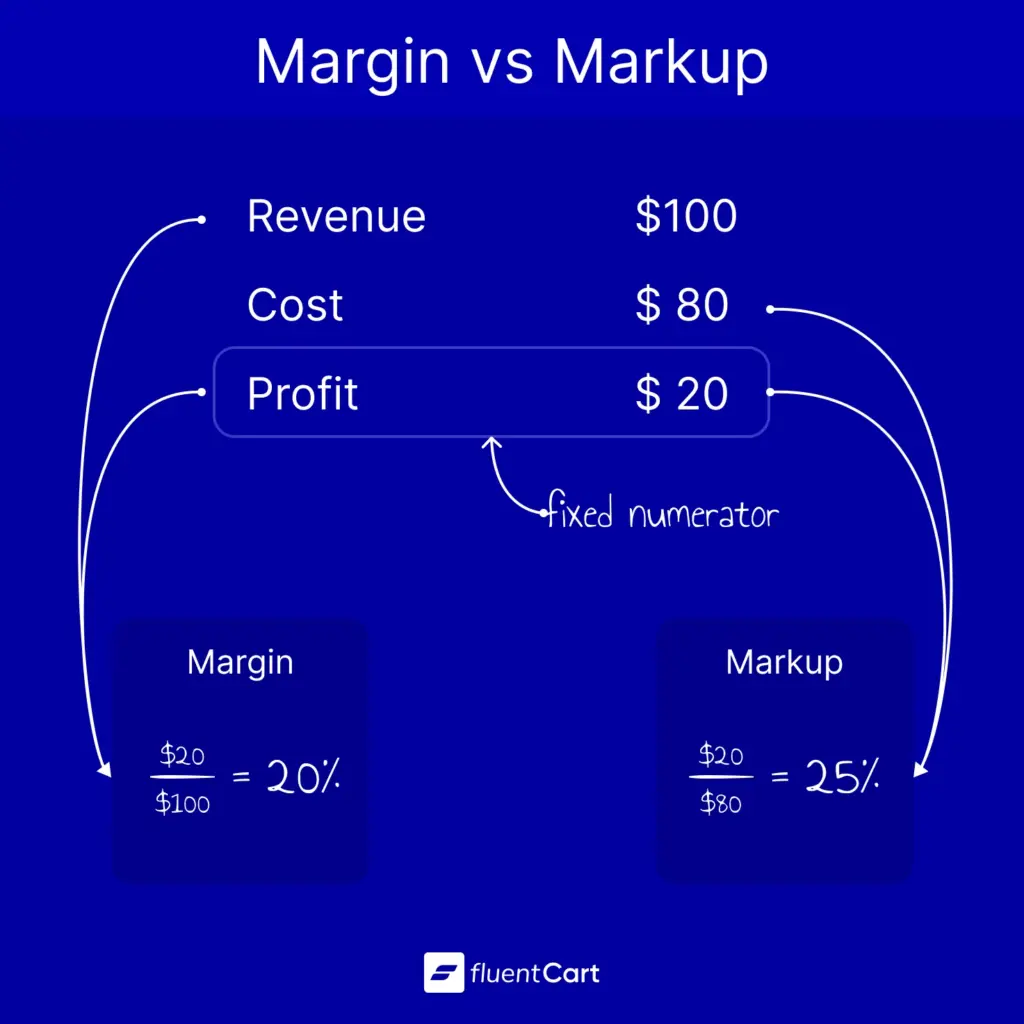
- Markup: The percentage added to your cost to get the final selling price. (It looks backward at what you spent).
- Margin: The percentage of the final selling price that is profit. (It looks forward at what you keep).
Business owners love to talk about margin, but they almost always calculate using markup because the math is easier to do in their heads.
2. The 50% Illusion (The Brutal Math)
Let's look at the math from the example above.
Your cost is $10,000. You want a 50% profit margin.
The Wrong Way (Using Markup):
- Cost: $10,000
- Markup: 50% ($5,000)
- Selling Price: $15,000
- Actual Margin: $5,000 profit / $15,000 price = 33.3%
If you want to actually keep 50% of the final selling price as profit, you have to use a completely different formula.
The Right Way (Using Margin): The formula for Margin is: Price = Cost / (1 - Desired Margin)
- Cost: $10,000
- Desired Margin: 50% (0.50)
- Formula: $10,000 / (1 - 0.50) = $20,000
- Selling Price: $20,000
- Actual Margin: $10,000 profit / $20,000 price = 50%
Look at the difference. To achieve a 50% margin, you actually have to apply a 100% markup to your costs. By doing the math wrong, you underpriced the project by $5,000.
3. The Danger of Discounting a Markup
This mathematical error becomes catastrophic when a client asks for a discount.
Let's say you used the wrong math. You marked up a $10,000 cost by 20%, resulting in a selling price of $12,000. (Your actual margin here is only 16.6%).
The client pushes back and asks for a 10% discount on the total price.
You think, "Okay, I marked it up 20%, I can give them 10% and still make a 10% profit."
Wrong again.
- Selling Price: $12,000
- 10% Discount: -$1,200
- New Price: $10,800
- Cost: $10,000
- Profit: $800
Your profit margin just plummeted to 7.4%. If your project runs even a few hours over budget, you are legally bound to deliver the project at a net loss.
When you base your discounts on markup percentages instead of margin percentages, a seemingly small concession can wipe out your entire profit pool.
4. The Standard Multipliers
If you are going to do the math in your head, you need to memorize the relationship between margin and markup.
- To get a 20% Margin, you need a 25% Markup.
- To get a 30% Margin, you need a 43% Markup.
- To get a 40% Margin, you need a 67% Markup.
- To get a 50% Margin, you need a 100% Markup.
The higher the margin you want, the exponentially higher the markup must be.
5. Automate the Math (Do Not Trust Spreadsheets)
You cannot expect your sales team to remember this formula while they are on a Zoom call trying to close a deal.
If they are building quotes in a blank Excel spreadsheet, they will inevitably use a basic multiplication formula (Markup) instead of the division formula (Margin). They will think they are protecting the company's profitability while quietly destroying it.
You must hardcode your financial logic into your quoting engine.
By using a dedicated platform like AutoQuote, you remove the human error. You configure the backend so the software automatically calculates the true margin based on fully burdened labor and overhead costs. Your sales reps simply input the scope, and the system ensures the final price always hits the required margin threshold before the proposal is ever generated.
Stop doing mental math. Understand the difference between what you spend and what you keep, and force your quoting process to respect the division.